
Observe nature in summer: binoculars or a spotting scope?
Summer is the ideal season to explore nature, whether you’re hiking in the mountains, taking a forest stroll, or birdwatching in the plains. But given the diversity of landscapes and species to observe, the question of which instrument to choose often arises: is it better to opt for binoculars or a spotting scope? This article will guide you through the advantages and specifics of each piece of equipment, to help you make the best choice according to your needs and desires.
\nAdvantages of binoculars: compactness and versatility
\nBinoculars are the preferred tool for many nature enthusiasts, and for good reasons. Their first asset is their compactness: easy to carry, they can be slipped into a backpack or worn around the neck without getting in your way. This mobility makes them the ideal companion for hikers or walkers who want to observe wildlife and flora throughout their walk, without having to stop for long.
\nThe versatility of binoculars is also a strong point. They allow you to quickly switch from one subject to another, adjust the focus in one motion, and observe both birds in flight and ground animals or distant panoramas. Compact models (8x25, 10x32, etc.) are particularly suited to nomadic use, while models with a wider objective (10x42, 8x56) will offer better brightness for observing at dusk or dawn.
\nFrom an ergonomic standpoint, binoculars allow natural observation with both eyes, reducing visual fatigue during prolonged sessions. Finally, their entry price is affordable, making them an attractive option for starting out without breaking the bank.
\nAdvantages of the spotting scope: magnification and precision
\nThe spotting scope, or spotting scope, appeals to ornithology or digiscoping enthusiasts seeking precise details at long distance. Its main advantage lies in its strong magnification (often 20x to 60x, or more) and the size of its objective, which can reach 80 mm or more. This configuration allows comfortable viewing of very distant subjects, such as a raptor perched on a cliff or a group of waterfowl on a pond.
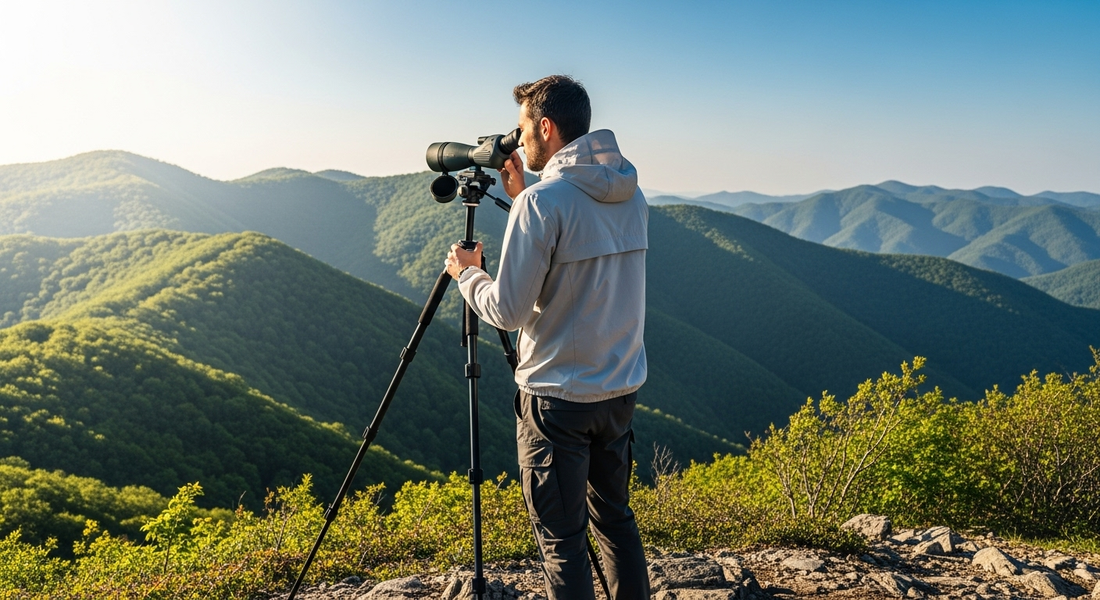
\nThe spotting scope excels in stationary observations, when the user can settle at a fixed position, for example in a hide or at a panoramic observation point. Mounted on a tripod, it provides a stable and bright image, even in strong summer heat that can cause mirages. For photography enthusiasts, it is also valuable thanks to digiscoping, enabling spectacular wildlife images.
\nHowever, the spotting scope is more cumbersome and heavier than binoculars, often requiring a tripod and a suitable bag for transport. It is therefore not the most practical choice for mobile or spontaneous observation.
\nWhich choice for which purpose?
\nThe choice between binoculars and the spotting scope depends mainly on your mode of observation:
\n- \n
- \nFor hikers and mobile naturalists : Binoculars are the ideal companion. Their lightness, ease of use, and ability to follow animals in motion or to explore different environments make them the all-terrain tool par excellence. \n
- \nFor stationary or specialized observation : If you practice ornithology, digiscoping or enjoy observing over long distances, the spotting scope is a must. It allows you to examine details invisible to binoculars and to enjoy exceptional visual comfort on long sessions. \n
- \nFor families or groups : Binoculars are often easier to share, while a single-post spotting scope will require organization so everyone can enjoy it. \n
Some experienced observers even choose to combine the two instruments: binoculars for spotting and following subjects, the spotting scope to deepen the observation once the point of interest is found.
\nTips for choosing your instrument well
\n- \n
- \nDefine your needs: Favor binoculars if you seek versatility and mobility, the spotting scope if you aim for long-range performance. \n
- \nConsider the bulk: For light hiking, opt for compact binoculars. For fixed sessions, the spotting scope and a tripod will not pose a problem. \n
- \nCheck optical quality: Treated lenses, brightness index, field of view… All these criteria influence comfort and observation quality. \n
- \nThink about the weather: Summer exposes you to variations in light and heat; favor waterproof and anti-fog instruments. \n
Conclusion
\nBinoculars and the spotting scope are two complementary instruments that meet different needs when observing nature in summer. For mobility, spontaneity and versatility, binoculars are favored. For precision, digiscoping and long-distance observation, the spotting scope is unbeatable. The choice will always depend on your expectations, the terrain and your habits: the essential is to fully enjoy the richness and beauty of the summer landscapes!