
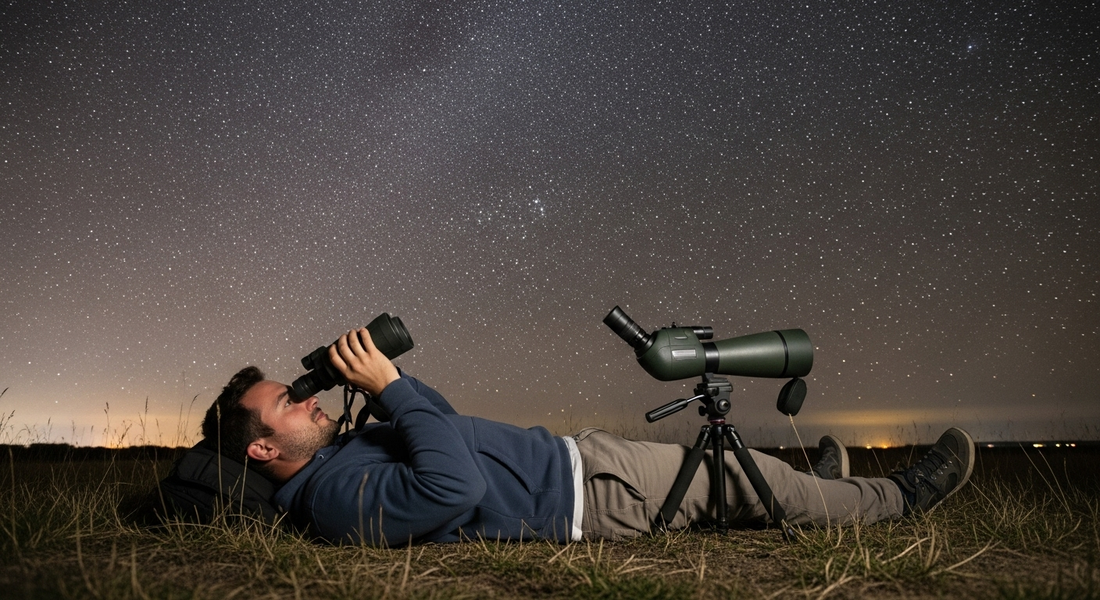
Observing meteor showers in summer : astronomical binoculars vs telescope
Summer, the ideal season for sky observation
Each year, at the end of July and the beginning of August, the celestial spectacle of shooting stars animates the summer nights. The Perseids, one of the meteor showers most eagerly anticipated, reach their peak during this period, offering astronomy enthusiasts a unique opportunity to admire dozens of shooting stars per hour. Thanks to the mild temperatures and the length of the nights, this season is particularly conducive to sky-watching, whether you are a beginner or a seasoned enthusiast.
Why is the late July/early August period ideal?
The Perseids result from the Earth passing through the dust trail left by the Swift-Tuttle comet. Their peak activity, usually around August 12, co"incides" with optimal observing conditions: warm nights, clear skies, and a frequent absence of clouds. In addition, this period often offers low moonlight, allowing the ballet of meteors to be better distinguished and also to observe planets visible to the naked eye such as Jupiter, Saturn, or Mars.
Astronomical binoculars: versatile allies
Astronomical binoculars are often the first instrument used by amateurs to explore the celestial vault. Their main asset lies in their wide field of view, which allows taking in large portions of the sky. To observe shooting stars, this wide field is ideal: it maximizes the chances of capturing the fleeting passage of a meteor. Binoculars of the 10x50 or 12x60 type offer a good compromise between power and brightness, while remaining relatively light and easy to handle.
In addition to shooting stars, binoculars reveal unsuspected details, such as star clusters, diffuse nebulae, or even Jupiter's satellites. Their use is intuitive, not requiring long preparations or complex adjustments. Finally, their compactness makes them portable, from mountains to the countryside, to enjoy a clear sky far from light pollution.
Spotting scope: magnification and precision
The spotting scope, originally designed for terrestrial observation (bird watching, landscapes), also has a place under the stars. Its main advantage lies in its high magnification, which allows detailing celestial objects such as the Moon, Saturn's rings, or the phases of Venus. Unlike binoculars, the spotting scope offers a reduced field of view, which makes it less suited to chasing shooting stars, but ideal for precisely scanning a planet or the lunar surface.
Mounted on a tripod, the spotting scope provides essential stability for high-magnification observing. It also allows precise focusing, revealing unsuspected details. However, its portability is lower and its narrow field requires careful targeting of the object to observe. For observing the Perseids, it can be used to admire the bright trail left by an exceptionally bright meteor, but it excels mainly for nocturnal planetary observations.
Practical tips for a successful observation
- Choose a location free from light pollution: prefer the countryside, the mountains, or any area far from urban lights. A dark sky increases the chances of seeing meteors and reveals more detail of celestial objects.
- Prepare your equipment: check the condition of your binoculars or spotting scope, remember to bring a stable tripod (especially for the spotting scope), warm clothing, and a red-light headlamp to preserve your adaptation to darkness.
- Adapt your night vision: give your eyes 15 to 20 minutes to get used to the dark. Avoid bright screens before and during the observation.
- Direct your gaze toward the celestial vault: for the Perseids, look toward the constellation of Perseus, in the east-northeast, but don't hesitate to sweep the entire sky with your binoculars to maximize discoveries.
- Patience and comfort: settle in comfortably on a lounge chair or a mat on the ground, to fully enjoy the show without fatigue.
The final word
Summer is the perfect season to start or deepen your astronomy practice. Astronomical binoculars appeal with their simplicity and versatility, while the spotting scope will delight lovers of planetary details. Whatever your choice, the important thing remains to lift your eyes, take your time, and savor the magic of starry nights.